
We need to talk about that feeling. 😬 That sinking sensation in your stomach when a tooth starts to ache, and your first thought isn’t about the pain, but about the cost. If you don’t have dental insurance, that feeling can be overwhelming. You might feel stuck, wondering if you have to choose between your health and your bank account.
If that’s you right now, please hear this: that worry is so common, and it makes perfect sense. 💙 Dental care can feel confusing and expensive, and nobody teaches you how to shop for it like a normal life skill.
Please, take a deep breath. You are not alone in this, and you have more options than you think. ❤️
Here at DentalSavings.cloud, we’re an educational team—not dentists—and our entire job is to help you understand your choices. We spend our days researching the fine print and translating it into plain English. This guide is designed to be your calm, clear roadmap to finding affordable dental care without insurance. We’ll walk you through the options, explain how they work, and help you find a path that feels right for you.
And just to reassure you upfront: you don’t have to “tough it out,” and you don’t have to feel embarrassed about asking for help with cost. 💬 Money conversations in healthcare are normal—even if they feel awkward at first.
Let’s get you from a place of worry to a place of confidence. 😊
Why Is Dental Care So Expensive, Anyway?
It’s a fair question, and one many people ask. It often feels like dental costs are in a world of their own. And when you’re staring at a treatment plan you didn’t expect, it can feel personal—like, “Why is this happening to me?” 😬
That reaction makes total sense. Most people are not budgeting for dental emergencies, because—honestly—life is already expensive.
Understanding why dental care costs what it costs can help demystify the numbers on your treatment plan, and it can also help you ask better questions.
Think about what goes into a modern dental office. There’s the highly specialized education and training for dentists, hygienists, and assistants. There’s the advanced technology, like digital X-rays and 3D imaging machines, which are incredibly expensive to buy and maintain. Plus, there are the high-quality materials for fillings, crowns, and implants, as well as the lab fees for custom work.
Also, dental offices are basically mini medical facilities. They have strict safety and sterilization requirements. They have staff, rent, equipment maintenance, and supply costs that don’t stop—even on slow days. 🦷
When you have dental insurance, the insurer has negotiated rates and agrees to pay a portion of those costs. Without it, you’re facing the full “cash price,” and that can cause some serious sticker shock.
And here’s another layer people don’t always realize: prices vary wildly by location. A cleaning or filling can cost more in one city than another, even if the procedure is identical. So if you’ve ever thought, “Why is my friend paying less than me?”—you’re not imagining it. ✨
But facing that price doesn’t have to be the end of the story.
You can often reduce your cost through one (or more) of these approaches:
- getting access to pre-negotiated rates,
- choosing clinics designed for lower-cost care,
- using a sliding scale program,
- asking about payment and cash options,
- comparing a couple offices (without feeling guilty about it),
- and focusing on “value” instead of “cheapest.”
That last point matters. Because “cheap” can sometimes become expensive later if problems aren’t treated the right way. And if you’re worried about that, you’re not being dramatic—you’re being smart. 💙
The Two Main Paths for Savings: Insurance vs. Discount Plans
When people think about saving on dental care, their minds usually jump straight to traditional insurance. That’s normal. It’s what most of us hear about first, usually through employers.
But it’s not the only option, especially if you need care soon. The other major player is the dental discount plan. Understanding the difference is the single most important step you can take. 😊
It’s a little like the difference between a subscription (like Costco) and a complex contract. One gives you access to lower prices right away, and the other involves a more complicated relationship with deductibles, waiting periods, and annual limits.
And if you’re thinking, “Okay… but which one actually helps me this month?”—you’re asking the right question. 💬
Let’s break it down side-by-side.
| Feature | Traditional Dental Insurance | Dental Discount Plans |
|---|---|---|
| How It Works | You pay a monthly premium. The insurance company pays a percentage of your dental bills after you meet a deductible. | You pay a low annual or monthly fee. You get instant access to a network of dentists who have agreed to give you discounted rates (e.g., 10-60% off). |
| Waiting Periods | Yes, often. You may have to wait 6-12 months for major procedures like crowns or root canals. | No. Your plan is typically active within 1-3 business days. You can use it for any procedure immediately. ✨ |
| Annual Limits | Yes. Most plans have a yearly maximum they will pay, often around $1,500. After that, you pay 100% of the cost. | No. You can use your plan as many times as you need throughout the year, with no cap on savings. |
| Deductibles | Yes. You have to pay a certain amount out-of-pocket (e.g., $50-$100) before your coverage kicks in. | No. There are no deductibles to meet. Your savings start with your first visit. |
| Paperwork/Claims | Yes. You or the dentist’s office will need to file claims and wait for reimbursement approvals. | No. There are no claim forms to file. You simply show your membership card and pay the discounted rate directly at the office. |
| Cosmetic Dentistry | Usually not covered (e.g., teeth whitening, veneers). | Often includes discounts on cosmetic procedures. |
| Best For | People who can plan ahead, have employer-sponsored options, and want coverage for preventative care. | People who need dental work soon, don’t have insurance, or have hit their insurance annual limit. |
Seeing it laid out like this often brings a sigh of relief for people. It shows there’s a straightforward, immediate alternative to the complexities of insurance.
And if you’re worried you’re “doing something sketchy” by using a discount plan—please don’t. 😬 That’s a really common concern. Discount plans are simply a pricing arrangement: dentists choose to participate, and you get access to those lower negotiated fees. There’s no hidden “catch” the way people fear.
The real “gotcha” is usually simpler: the plan needs to have a strong network in your area, and you need to confirm your dentist accepts the specific plan before you book. That’s it. 💙
For a more detailed breakdown, understanding how these two options function is key. You can learn more about the specifics in our guide on dental discount plans vs. insurance.
Your Action Plan for Affordable Dental Care Without Insurance
Okay, you understand the landscape. Now, let’s get practical. Here are the most effective strategies for getting the care you need at a price you can manage.
And before we jump in—if you’re feeling overwhelmed, that’s normal. ❤️ A lot of people read “options” and their brain hears “more decisions.” So we’re going to keep this simple: you can pick one strategy to start, and you can layer in others if needed.
You can even mix and match some of these approaches!
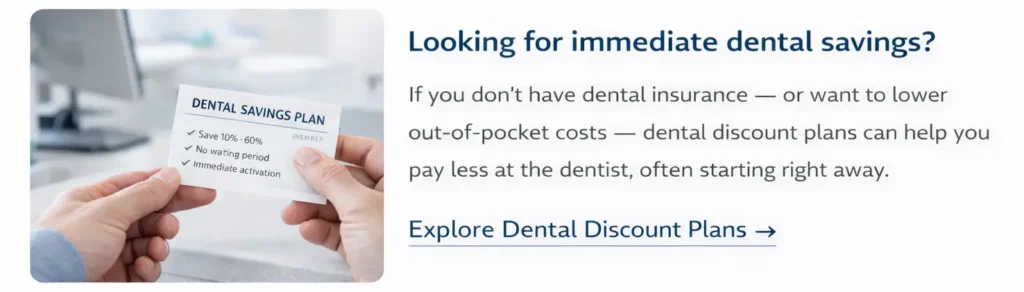
Option 1: Dental Discount Plans (The Instant Savings Route) ✨
This is often the fastest and most direct way to lower your costs for affordable dental care without insurance.
Think of it like this: You join a plan, and you’re instantly part of a club that gets pre-negotiated low prices at thousands of dentists nationwide. You pay a small annual fee (often around $100-$150 for an individual or family), and in return, you get significant discounts on everything from cleanings and fillings to crowns, root canals, and even braces.
If you’re thinking, “That sounds too easy,” you’re not alone. 😬 But this is exactly why discount plans can be such a relief—there’s no waiting period, no claim filing, no approval letter to sit around hoping for.
Let’s use a quick example. Imagine you need a crown, and the dentist’s normal cash price is $1,400. With a good discount plan, that price might be reduced to $800. You just saved $600 on a single procedure—far more than the cost of the plan itself. 💙
Here are a few situations where discount plans tend to shine:
- You need treatment soon (pain, broken tooth, cavity that can’t wait).
- You need more than one thing done this year.
- You’ve been quoted a treatment plan and want a way to reduce the price quickly.
- You want predictable “discounted fees” rather than surprise billing.
And here’s a small, very real micro-moment many people relate to:
Picture this: you’re sitting at your kitchen table, looking at a treatment estimate, and your mind is racing. 😬 Then you find out you can reduce that price by hundreds—sometimes on the same week. That shift from “panic” to “plan” is powerful.
The process is incredibly simple:
- Join a Plan: Sign up online for a plan that has dentists you like in your area.
- Get Your Card: You’ll typically get an instant membership ID you can print or show on your phone.
- Book Your Appointment: When you call the dentist, confirm they accept your specific plan.
- Show Your Card & Save: At your visit, present your card. You’ll pay the lower, discounted fee directly to the office. No paperwork, no waiting.
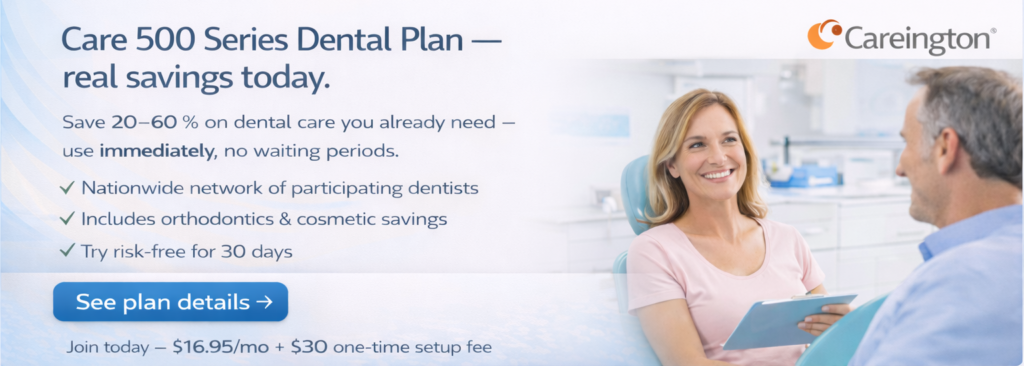
https://dentalsavings.cloud/recommends/careington-dental-plan/Popular and trusted plans like the Careington Care 500 Series are widely accepted and known for their significant savings. The key is finding a plan with a strong network of dentists in your local area.
Now, a quick “real-life” tip that can save you stress:
When you call an office, don’t just ask, “Do you take discount plans?” Ask the specific plan name. 💬 Offices often participate in some networks and not others.
You can use a simple script like:
- “Hi! I’m looking for a new patient appointment. Do you accept the Careington Care 500 discount plan? And if so, can you confirm I’d be paying the plan’s contracted rates?”
That little phrase—“contracted rates”—signals you understand how it works. 😊
Also, if you’re comparing two offices, it’s completely fair to ask for a ballpark estimate for a common service (like an exam + X-rays + cleaning) under your plan. Some offices will give a range over the phone, and even if they don’t, you’ve still learned something about their transparency.
Pro Insight from Our Team
When choosing a dental discount plan, the network is everything. A plan is only as good as the dentists who accept it. Before you sign up, always use the plan’s online “dentist finder” tool. Search by your zip code and even by a specific dentist’s name if you have one you’d like to see. A large, reputable network means you’ll have more choices and a better chance of finding a great dentist conveniently located near you. It only takes a few minutes and prevents any surprises later.
One more reassuring note: you don’t have to “get it perfect” on your first try. ❤️ If you choose a plan and later realize you want a different dentist, the whole point of a network is flexibility. The goal is to get you care—without the feeling that cost is trapping you.
Option 2: Dental Schools and University Clinics 🎓
If you have some flexibility with your time, a dental school can be an excellent source of high-quality, low-cost care.
And if your first thought is, “Wait… students?”—totally understandable. 😬 That question is so common. The important part is supervision: dental students (especially in later years) work under experienced, licensed faculty. It’s a learning environment, which often means the care is carefully checked and very methodical.
Here’s the deal: Dental students in their final years of training need to perform procedures on real patients to graduate. They are supervised every step of the way by experienced, licensed dental school faculty. Because it’s a learning environment, the costs are drastically reduced—sometimes 50% or more compared to a private practice.
What to Expect:
- Lower Costs: This is the main benefit. The savings can be huge.
- High-Quality Care: Everything is double-checked by a professor, so the work is often meticulous.
- Longer Appointments: The trade-off is time. Appointments will take much longer than usual because of the teaching and supervision involved. A procedure that takes 90 minutes at a private dentist might take a full afternoon at a dental school.
- Potential Waitlists: They can be very popular, so you may have to wait to get an initial appointment.
Here’s a helpful way to think about it: a dental school is often best when your situation is important—but not “right this second.” 💙
For example:
- You need a couple fillings and a deep cleaning.
- You need a crown but you can wait a bit longer.
- You want comprehensive care and a thorough evaluation.
- You’re trying to build a long-term plan for your dental health on a limited budget.
That said, even dental schools sometimes have urgent clinics or faster triage pathways, depending on the program. If you’re in pain, it’s still worth calling and asking how quickly new patients can be seen. 💬
This is a fantastic option if your dental needs aren’t an immediate emergency and you live near a university with a dental program. The American Dental Association (ADA) maintains a list of accredited dental schools you can search.
And just emotionally—because this matters too—many people feel less judged in a teaching clinic. 😊 The vibe can be more “we’re here to help and teach,” which can feel gentler if you’ve been avoiding the dentist due to cost or anxiety.
Option 3: Community Dental Clinics and FQHCs ❤️
Across the country, there are community health centers and Federally Qualified Health Centers (FQHCs) dedicated to providing medical and dental care to people in their local area, regardless of their ability to pay.
If you’ve never used one before, you’re not alone. And if you’re wondering, “Are they only for emergencies?”—great question. 💬 Many provide preventative care too, and for a lot of people, this becomes their main way to access routine dental services.
Many of these non-profit clinics offer dental services on a “sliding scale.” This means the amount you pay is based on your income. If your income is lower, you pay less. They receive government funding to help make this possible.
These clinics are lifesavers for millions of Americans. They provide essential services like exams, cleanings, fillings, and extractions. While they may not offer complex cosmetic procedures, they are a vital resource for maintaining your oral health and addressing painful problems. You can find a federally supported health center near you using the official tool from the U.S. Health Resources and Services Administration (HRSA).
Here are a few practical tips to make this option smoother:
- Call early in the day if possible. Some clinics fill appointment slots quickly. ☕
- Ask what documents they need (proof of income, ID, residency).
- If you have pain, mention it clearly—many clinics prioritize urgent needs.
- Ask if they have a cancellation list. A lot of people get in sooner that way. 😊
And if you’ve been feeling ashamed about needing a sliding-scale clinic, please don’t. ❤️ That shame is incredibly common—and completely undeserved. Community clinics exist because dental care is essential, and people deserve access to it.
Option 4: A Frank Conversation with Your Dentist’s Office 💬
Never underestimate the power of a respectful, honest conversation. Dental offices understand that people face financial challenges, and many are willing to work with you, especially if you’re a long-time patient.
If talking about money makes your heart race a little… yep. 😬 That’s normal. Most of us weren’t taught how to negotiate healthcare costs. But here’s the good news: dental offices have financial coordinators for a reason. This is literally part of their job.
Here are a few things you can ask about:
- Cash Discount: Many offices offer a small discount (maybe 5-10%) if you pay for your treatment in full upfront with cash or a check. This saves them credit card processing fees and the administrative hassle of billing.
- In-House Payment Plan: Some larger practices have their own internal financing plans. They might allow you to pay off a large treatment bill over 3-6 months without any interest.
- Third-Party Financing: For bigger procedures, most offices partner with healthcare financing companies like CareCredit. These work like a credit card specifically for health expenses and often have interest-free periods if you pay the balance within a certain timeframe (e.g., 6, 12, or 18 months). Just be sure to read the terms carefully, as the interest can be high if you don’t pay it off in time.
A couple more “real world” questions that can help:
- “Is there a less expensive treatment option that still solves the problem safely?” 🦷
- “Can we phase the treatment? What must be done now vs. later?”
- “If I do this in two visits, does the cost change?”
- “Do you offer a new patient special for exam/X-rays?” (Some do.)
It can feel a little intimidating to talk about money, but remember: their financial coordinator has these conversations every single day. It’s a normal part of their job. Being proactive and polite can open up solutions you didn’t even know existed.
And here’s a tiny micro-story moment that’s very real:
Imagine you’ve been avoiding making the appointment because you’re scared of the number. 😬 Then you ask one calm question—“Do you offer any payment options?”—and suddenly there’s a plan. You still might not love the cost, but now you’re not stuck. That’s the point.
A Note on “At-Home” Solutions
The rise of teledentistry and mail-order services has introduced new options, but it’s important to know their limits. These are best for specific, non-clinical needs.
And if you’re reading this thinking, “I just need something affordable at home because I can’t deal with an office right now”—that feeling makes perfect sense. 💙 Convenience can feel like relief when you’re stressed.
For example, if you grind your teeth and need a custom night guard, or need a replacement retainer, services like iHomeDental can offer a convenient and affordable way to get a custom-fitted device made from an at-home impression kit.
However, this is NOT a replacement for seeing a dentist. For anything involving pain, infection, or changing your bite (like aligners), you absolutely need an in-person examination and diagnosis from a licensed professional.
A simple way to think about it:
- If it’s a device you already know you need (like a night guard for grinding), at-home can sometimes help. ✨
- If you’re unsure what’s going on (pain, swelling, sudden sensitivity, gum issues), you need an exam.
And if you’re trying to “DIY” a serious dental issue because you’re afraid of cost, please be gentle with yourself. ❤️ That fear is real. But untreated problems often get more expensive over time. Even a low-cost clinic visit or discount plan appointment can prevent bigger costs later.
How to Choose the Right Path for You
With all these options, how do you decide? It really comes down to your unique situation. And if you’re thinking, “I just want someone to tell me the best choice,” that’s a very human feeling. 😊
So here’s the goal: not “perfect,” just “right enough to start.”
Let’s create a little micro-guide to help you think it through.
✅ Your Quick Checklist for Choosing a Dental Savings Option
Grab a cup of coffee ☕ and ask yourself these four simple questions. Your answers will point you toward the best solution.
1. What’s my immediate need?
- “It’s an emergency! I’m in pain right now.” → Your best bet is likely a dental discount plan, which you can activate almost instantly and use for urgent care. Also, call community clinics, as they may have emergency slots.
If you’re in pain, it’s very normal for your brain to jump to worst-case thoughts. 😬 Try to focus on the next practical step: get seen and get a real plan.
- “I need major work (like a root canal or implant) in the next few weeks.” → A dental discount plan is ideal here, as it has no waiting periods. A dental school could also work if their waitlist is short.
And just to validate something here: major work can feel emotionally heavy—not just financially heavy. 💙 It can bring up fear, regret, or embarrassment. None of that helps you solve it. A plan does.
- “I just need a routine check-up and cleaning.” → Any of these options will work well! A community clinic or dental school offers the lowest out-of-pocket cost. A discount plan makes private practice more affordable.
2. What’s my budget for an upfront fee?
- “I can afford a reasonable annual fee for big savings.” → A dental discount plan (around $100-$200/year) is a perfect fit.
This can feel like a “small risk,” and it’s okay to feel cautious. 😊 The key is checking the dentist network first so you don’t feel blindsided.
- “I have little to no budget right now.” → Focus on community health centers with sliding-scale fees or get on the waitlist for a dental school.
If you’re in that situation, please don’t beat yourself up. ❤️ It’s not a character flaw. It’s real life. These programs exist because people need them.
3. Do I have a preferred dentist?
- “Yes, I love my dentist and want to keep seeing them!” → Your first step is to call their office and ask which discount plans they accept. Many participate in major networks. You can also start by checking which dentists in your zip code accept a popular plan. 💙 Many people begin their search to find a dentist near them that accepts plans like the Aetna Dental Access or Careington 500 Series.
Sometimes this is the biggest emotional relief—keeping a dentist you trust, while making the cost manageable. 🦷 Trust matters.
- “No, I’m open to seeing someone new.” → This gives you maximum flexibility! You can choose any dentist within a discount plan’s network, or go to a dental school or community clinic. Learning how to find an affordable dentist can be a very empowering step in this process.
4. How flexible is my schedule?
- “I work 9-to-5 and my time is limited.” → A private dentist using a discount plan is your most efficient option.
- “I have a very flexible schedule.” → The longer appointments at a dental school could be a great way to access huge savings.
One extra gentle reminder: you can change your plan if your first pick isn’t ideal. 😊 The purpose of this checklist is to help you start moving—because movement reduces anxiety. Even one phone call or one search can shift you from “stuck” to “active.”
You’ve Got This: Taking the First Step Toward Affordable Dental Care
We know this is a lot of information. The most important thing to remember is that you are in control. That feeling of helplessness that comes with a dental problem and no insurance can be replaced with a feeling of empowerment. 💙
And if you’ve been putting this off because you’re afraid of what you’ll hear—again, that’s incredibly common. 😬 But avoiding dental problems usually doesn’t make them cheaper or easier. What does help is having a plan you can afford and understand.
You don’t have to ignore the problem and hope it goes away (which, as we know, it rarely does). By exploring dental discount plans, looking into local dental schools, or simply having an open conversation with a dentist’s office, you are taking a powerful step toward protecting both your health and your wallet.
Here’s a calm “one-step” suggestion, if you want it:
- If you need care soon: start by checking discount plan dentists in your zip code. ✨
- If money is extremely tight: call a community clinic and ask about sliding scale. ❤️
- If time is flexible: get on a dental school list and ask about wait times. ☕
Your journey to affordable dental care without insurance starts with this knowledge. Pick one thing from the checklist above and take the first small step today.
Whether it’s searching for a local dentist who accepts a discount plan, calling a nearby community clinic, or asking a receptionist one simple question about pricing, that single action will move you out of worry and into a solution. You can do this. 😊
Medical Disclaimer: Content on DentalSavings.cloud is for educational purposes only and not a substitute for examination or diagnosis by a licensed dentist. If you experience pain, swelling, or urgent dental symptoms, seek professional care immediately.
Affiliate Disclosure: DentalSavings.cloud participates in affiliate programs (including discount plan partners and other trusted partners). When you buy through our links, we may earn a small commission — at no extra cost to you. These partnerships help keep our guides accurate, independent, and free for readers.
© 2026 DentalSavings.cloud | All rights reserved.