
Let’s talk about that moment. 😬 You’re sitting in the dental chair, the exam is over, and the dentist starts explaining the treatment you need. A crown, maybe a root canal, or even just a few fillings. Your first thought is relief—you know what’s wrong. But your second thought, the one that makes your stomach tighten, is almost always: “How much is this going to cost?”
If that’s you, you’re not alone. That’s a very common worry — and it makes perfect sense. Dental pricing can feel like a surprise pop quiz you never studied for. One person pays one number, another person pays something totally different, and suddenly you’re trying to make a health decision while your brain is doing budget math at 100 miles per hour. 💬
And here’s the hard truth: that stress can cause people to delay care. Not because they don’t care about their smile. Not because they’re irresponsible. But because uncertainty is exhausting. When you don’t know what you’ll be asked to pay, it’s easy to freeze.
So today, we’re going to slow it down. We’re going to make it simple. 😊
Together, we’ll explore the Aetna dental savings plan, a popular option designed to help people reduce the cost of dental care without the complexity of traditional insurance. This isn’t a sales pitch. It’s a calm, clear conversation to help you understand what this type of plan is, how it works in real life, what it can and can’t do, and how to tell if it fits your situation. 💙
What Exactly Is a Dental Savings Plan? (It’s Not Insurance!)
Before we dive into Aetna specifically, let’s clear up the biggest point of confusion. A dental savings plan is not dental insurance. That difference matters. And if you’ve ever felt confused by this, that’s completely normal. The names sound similar, and the marketing can make it blurry. 😬
A dental savings plan is more like a membership program for dental discounts. Think of it like a Costco or Sam’s Club membership—just for dental care. 😊
You pay a low annual fee, and in return, you get access to pre-negotiated, discounted rates on dental services from dentists who participate in the plan’s network. That means the discount is already set ahead of time. You don’t have to “apply” or “qualify” based on your health history. You’re simply using a member price.
And that idea alone can feel like a breath of fresh air. ✨ Because instead of wondering, “Will they cover this?” you’re asking a more direct question: “What is the discounted price with this plan?”
Here’s what people typically like about savings plans:
- No deductibles. You don’t need to spend a certain amount before savings start.
- No waiting periods (in most cases). You can often use it quickly after enrollment.
- No annual maximums. There’s usually no limit to how much you can save in a year.
- No claim forms. You don’t file paperwork or wait for reimbursement.
If you’ve ever dealt with insurance “rules,” you can see why this feels simpler. That simplicity is the point. 💙
And emotionally? It can be a big deal. Imagine checking your budget and feeling less stressed because you have a clearer price range in your head. Imagine scheduling a cleaning without worrying you’re walking into a financial surprise. That calm matters. ❤️
The Aetna Dental Savings Plan vs. Traditional Insurance: A Clear Comparison
If you’ve been trying to decide between a discount plan and insurance, you’re asking the right question. That comparison is where most people finally get clarity. And yes — it’s totally normal to feel overwhelmed by the terminology. You’re not “behind.” You’re just trying to make a smart decision in a system that’s not always designed to be easy. 💬
Grab a cup of coffee ☕ and let’s put this side-by-side in plain English.
| Feature | Aetna Dental Savings Plan (A Dental Discount Plan) | Traditional Dental Insurance |
|---|---|---|
| How it Works | Pay an annual fee to access a network of dentists offering 15-50%* discounts. | Pay a monthly premium. The insurance company pays a portion of your dental bills. |
| Waiting Periods | None. You can typically use your plan within 24-72 hours of activation. | Common. You may have to wait 6-12 months for major procedures like crowns or implants. |
| Deductibles | None. Your discounts apply from day one. | Yes. You must pay a certain amount out-of-pocket before coverage kicks in. |
| Annual Maximums | None. There is no limit to how much you can save in a year. | Yes. Most plans have an annual cap, often around $1,500–$2,000. |
| Paperwork & Claims | None. No claim forms to fill out or waiting for reimbursement. | Yes. You or your dentist must file claims for services, which can be complex. |
| Cosmetic Dentistry | Often includes discounts on services like teeth whitening and veneers. | Usually not covered. |
| Pre-existing Conditions | No restrictions. Need a root canal on a tooth that’s been bothering you for years? You’re covered. | Sometimes excluded or subject to waiting periods. |
*Savings vary by procedure, dentist, and location.
When you see it like this, a pattern usually jumps out:
- Insurance is a “coverage” product. It may pay part of the bill, but it comes with rules, limits, and timelines.
- A savings plan is a “discount” product. It doesn’t pay for you — it reduces the price you pay.
That’s an important emotional difference too. 😊
If you need something soon, waiting periods can feel brutal. And if you’ve ever hit an annual maximum right when you needed more work, you know how frustrating that can be. That’s a very common worry — and it makes perfect sense.
A savings plan doesn’t solve every situation, but for the right person, it can remove a lot of mental stress. It can turn “I’m scared to ask what it costs” into “I can handle this if the price is lower.” 💙
How Does the Aetna Dental Savings Plan Actually Work?
Okay, now let’s make it real. How does this actually play out when you’re trying to schedule an appointment?
If you’re someone who likes straightforward steps, you’re going to appreciate this part. The process is usually simple, and that simplicity is often what people are paying for—less friction, fewer surprises, more control. ✨
Here’s the typical flow:
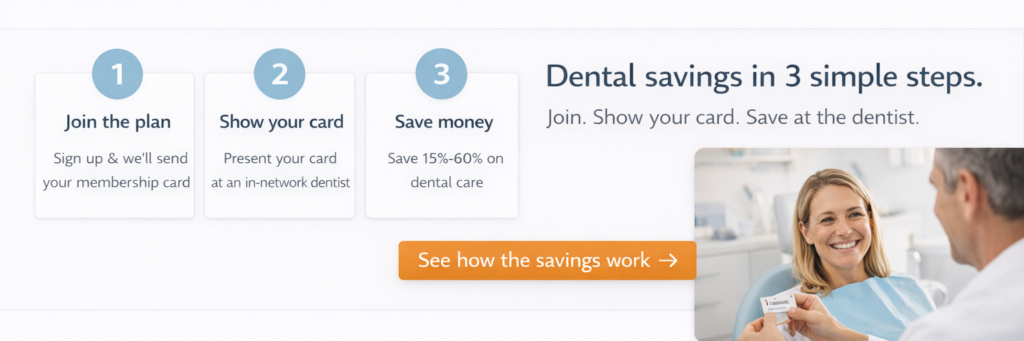
- Enroll in the Plan: You sign up online or over the phone. It’s a quick process, and you’ll pay a low annual membership fee.
- Get Your Membership Card: You’ll receive your membership materials, often instantly via email, so you can start using the plan right away.
- Find a Participating Dentist: This is the most important step! The discounts only apply to dentists within the plan’s network.
- Schedule Your Appointment: When you call to make an appointment, mention that you are a member of the Aetna Dental Access® network.
- Show Your Card & Save: At your visit, simply present your membership card. The dental office will charge you the discounted rate for the services you received. You pay the dentist directly.
That’s it. And if you’re thinking, “Wait… so there’s no claims, no reimbursements, no paperwork?” — yes. That’s the point. 😊
This is also why many people like using a savings plan when life is already complicated. Maybe you’re juggling work, family, and bills. Maybe you’re self-employed and don’t want another monthly premium. Maybe you just want a clean, predictable way to reduce dental costs without learning an entirely new insurance language. That’s a very common motivation — and it makes perfect sense. 💙
Now, one more gentle but important detail: even though the steps are simple, your experience depends heavily on one thing…
Pro Insight: Understanding the “Network” is Key
Here at DentalSavings.cloud, our team spends a lot of time helping people understand the details that matter most. One of the biggest is the “network.” The Aetna dental savings plan operates on the Aetna Dental Access® network. This is a large, nationwide network of dental providers who have agreed to offer their services at a reduced fee for plan members.
Why is this important? Because your savings depend entirely on seeing an in-network dentist. If you visit a dentist who isn’t part of the network, your plan won’t provide any discounts there. The good news is that these networks are extensive, but you should always verify a dentist is participating before your appointment. It’s a simple check that ensures you get the savings you expect, with no surprises.
If you’ve ever had that sinking feeling of showing up somewhere only to find out “it doesn’t apply,” you already know why this matters. 😬 A two-minute confirmation call can save you a lot of stress, and it helps the whole visit feel smoother from the start. ❤️
Real-World Savings: What Could You Actually Pay?
This is usually the big question. And honestly, it’s the most human question too. Percentages are helpful, but when you’re trying to plan your life, you need real numbers you can picture.
That’s a very common worry — and it makes perfect sense.
Because it’s one thing to hear “15–50% savings.” It’s another thing to imagine the difference between:
- paying over $1,500 for a crown,
- versus paying hundreds less and being able to do it now.
Or imagine biting into ice cream without that zing of pain because you didn’t have to delay treatment. 😊
The table below shows typical price ranges for dental work in the U.S. and an estimated savings range you might see with a plan like the Aetna Dental Access® plan.
Important: These are just examples. Actual costs and discounts vary based on your dentist, location, and the specifics of your treatment plan. This is for educational purposes to illustrate how the savings can work.
| Dental Procedure | Typical Cost Range (Without a Plan) | Estimated Member Price (With a Plan) |
|---|---|---|
| Adult Cleaning & Exam | $200 – $400 | $75 – $150 |
| Composite (White) Filling | $150 – $450 | $70 – $200 |
| Root Canal (Molar) | $1,200 – $2,000+ | $700 – $1,200 |
| Porcelain Crown | $1,000 – $2,500+ | $600 – $1,400 |
| Simple Extraction | $150 – $400 | $60 – $150 |
Now, let’s talk about what these numbers feel like in real life.
If you’re someone who has been putting off a crown because it’s “too expensive right now,” saving a few hundred dollars can be the difference between doing it this month or delaying it until it becomes a bigger problem later. 😬
And if you’ve ever felt embarrassed about delaying care, please don’t. That’s an incredibly common experience. Dental costs are high, and people do the best they can with what they have. What matters is finding a path forward that feels realistic. 💙
Many people find the plan pays for itself with just one routine visit or a single filling. And if you need more significant work, the savings can stack up quickly.
Also, here’s something that helps emotionally: you’re not waiting for an insurance company to decide. You’re simply paying a lower, negotiated rate at the time of service. That directness can feel empowering. ❤️
For a deeper look at the mechanics of these savings, our guide on how dental discount plans work versus insurance breaks down the financial aspects even further.
Is an Aetna Dental Savings Plan the Right Choice for You? A Checklist 📝
Let’s make this personal—in a helpful way. Because the “best” plan isn’t the one with the fanciest marketing. It’s the one that fits your life.
That’s a very common worry — and it makes perfect sense: you don’t want to pick the wrong thing, pay for something, and then realize it doesn’t help you when you need it.
So here’s a checklist. Take a deep breath. Answer honestly. No pressure. 😊
- Do you currently have dental insurance?
- If no, a savings plan can be a fantastic and affordable way to get immediate access to discounts.
- If yes, consider if your insurance has limitations. Do you have a long waiting period for a procedure you need now? Have you hit your annual maximum? A savings plan can sometimes be used to supplement your insurance for non-covered services or after your benefits are exhausted (always check with your dentist and insurance provider).
- Do you need dental work soon?
- If you’ve been putting off a crown, root canal, or other major work because of the cost, the “no waiting periods” feature of a savings plan is a huge advantage.
- Are you self-employed, a freelancer, or a gig worker?
- Savings plans are incredibly popular with individuals and families who don’t have access to employer-sponsored dental benefits.
- Are you a senior or on a fixed income?
- For those on Medicare (which typically doesn’t cover routine dental), a savings plan provides a predictable way to manage dental costs without high monthly premiums.
- Are you okay with seeing a dentist within a specific network?
- If you’re flexible or willing to find a new dentist from a large list of providers, a savings plan is a great fit. If you are absolutely committed to your current dentist, you’ll first need to check if they are in the network.
If you’re reading that and thinking, “I just want something that helps me afford basic care without drama,” you’re exactly the kind of person who often benefits from this model. 💙
And if you’re thinking, “I need real help soon and I can’t wait six months,” that’s a very common worry — and it makes perfect sense. Waiting periods don’t feel “financial.” They feel personal. Because your mouth doesn’t pause pain on a schedule.
The goal here isn’t perfection. The goal is confidence. A plan that makes you feel like you can take the next step without fear. ❤️
Finding a Dentist Who Accepts the Plan
This is often the part that makes people hesitate. And I get it. You can like the idea of a plan and still wonder:
- “Will I actually find a dentist near me?”
- “What if my current dentist doesn’t take it?”
- “What if I pick someone and it doesn’t work?”
That’s a very common worry — and it makes perfect sense. 😊
Here’s the reassuring truth: these networks are usually large, and searching is easier than most people expect.
Many people start by checking which dentists in their zip code accept a discount plan 💙, and it’s a simple, calming step—because it turns “unknown” into “visible.” You can search by location and, in many tools, by specialty too.
- You can easily find a dentist near you that accepts the Aetna Dental Access® plan or other top plans like the Careington 500 Series using a dedicated search portal.
Once you see a list, here’s a practical tip: call the office and confirm participation before your appointment. It’s quick, and it protects you from the most common frustration people have with discount plans—assuming it applies without verifying. 😬
A simple script you can use on the phone:
- “Hi! I’m a member of the Aetna Dental Access® network. Are you currently participating, and do you honor the member fee schedule?”
Short, clear, done. 💬
And if you’re nervous about switching dentists, that’s completely normal too. Sometimes changing providers feels emotional. You may have history with your current office. You may hate “starting over.” Just remember: checking the network doesn’t force you to switch. It simply gives you options. ❤️
What to Watch Out For (The Honest Truth)
Transparency matters. And if you’re considering a plan like this, you deserve the full picture—not just the benefits.
That’s a very common worry — and it makes perfect sense: you don’t want to feel “tricked” by a plan that sounds good but doesn’t match your expectations.
So here are the key watch-outs, clearly and gently:
- It’s Not Insurance: We can’t say this enough. It won’t cover 100% of a catastrophic dental emergency. It’s a discount tool, not a comprehensive payment plan.
- Network Limitations: You must see a dentist in the network to get the discount.
- Specialist Availability: While networks are large, the availability of specialists (like endodontists or oral surgeons) can sometimes be more limited in rural areas. Always check for specialists if you know you need one.
- Discounts Aren’t Standardized: The percentage of savings varies by dentist and by procedure. The fee schedule will give you a clear idea of what to expect from your chosen provider.
Here’s the emotional takeaway: none of these are “dealbreakers” if you expect them. They become frustrating only when someone thinks they’re buying insurance and then learns it’s a discount plan. 😬
If you go in knowing what it is, you can use it powerfully. If you go in hoping it’s something else, it can disappoint you. That’s why education matters first. 💙
Also, one more realistic point: a savings plan doesn’t replace good planning. If you need major work, you still want to ask your dentist for a written treatment plan and a cost estimate. That’s not being “difficult.” That’s being smart. And you deserve clarity. ❤️
Taking the Next Step with Confidence
Let’s recap, gently.
You’ve learned what an Aetna dental savings plan is. You’ve seen how it differs from insurance. You’ve looked at real-world numbers. You’ve explored who this tends to help most—and what to watch out for.
If you’re feeling a little more hopeful right now, that makes sense. Tools like this can give people breathing room. And even just knowing you have options can ease that tight feeling in your chest when you think about dental costs. 💙
Imagine this: you’re looking at your calendar and you schedule your cleaning because you can afford it. You stop avoiding the appointment reminder. You walk in feeling more prepared, not more scared. 😊
That’s the emotional win here—confidence.
Now, if this approach feels right for you, exploring the specifics is the next logical step. You can view the details of a top-rated plan here:
And if you want to keep going—because maybe you’re trying to save on multiple procedures, or plan ahead for your family—our deeper resource on how to save money on dental work can help you build a broader strategy.
We know this is a lot to take in. That’s a very common worry — and it makes perfect sense. Dental decisions sit right at the intersection of health, money, and anxiety.
But you’re doing the right thing by learning first. You’re turning fear into information. And that’s how people make strong decisions. ❤️
Remember: taking care of your smile is part of taking care of your overall health. And you deserve to do it without financial panic or shame.
You’ve got this. ✨
Medical Disclaimer: Content on DentalSavings.cloud is for educational purposes only and not a substitute for examination or diagnosis by a licensed dentist. If you experience pain, swelling, or urgent dental symptoms, seek professional care immediately.
Affiliate Disclosure: DentalSavings.cloud participates in affiliate programs (including discount plan partners and other trusted partners). When you buy through our links, we may earn a small commission — at no extra cost to you. These partnerships help keep our guides accurate, independent, and free for readers.
© 2026 DentalSavings.cloud | All rights reserved.