
That little flutter in your stomach when the dentist says you need a crown. The quiet dread of looking at a treatment plan with a four-figure number at the bottom. We get it. 😬 For millions of Americans, the cost of dental care is a major source of stress, and the fear of a surprise bill can be enough to make you avoid the dentist’s chair altogether. It’s a feeling of being stuck, and it’s incredibly common.
And honestly? If you’ve ever thought, “I’ll deal with it later”—that makes perfect sense. When something feels expensive and confusing, your brain tries to protect you by hitting pause. 💬 But dental problems don’t really love “later.” They tend to get louder, not quieter.
But what if there was a simpler, more straightforward way to lower your dental bills without the complexities of traditional insurance? What if you could feel confident walking into your appointment, knowing exactly how you’ll save?
That’s where dental savings plans come in. ✨
We’re here to have a calm, clear conversation about how dental savings plans work. Think of us as your friendly educational team—not dentists, but people who spend their days making sense of dental costs so you don’t have to. We’ll walk you through everything, step-by-step, so you can feel empowered and in control of your dental health and your budget. Let’s begin. ☕
So, What Exactly Is a Dental Savings Plan? (And What It’s Not)
Let’s clear up the biggest point of confusion right away: a dental savings plan is not dental insurance.
If you’re thinking, “Okay… then what is it?”—you’re not alone. 😊 A lot of people hear “plan” and automatically picture premiums, deductibles, claims, waiting periods, and that whole maze. But a dental savings plan is built differently.
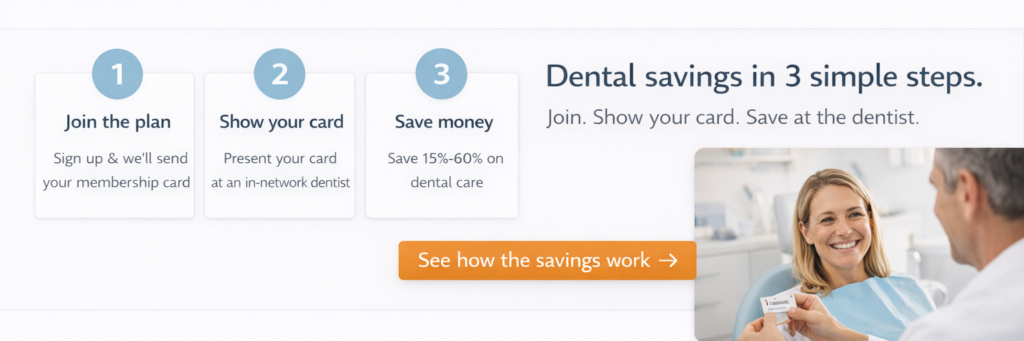
It’s much simpler. A dental savings plan is a membership program, a bit like Costco or AAA. You pay an annual fee to join, and in return, you get immediate access to a large network of dentists who have agreed to offer significantly reduced rates on their services—just for members of the plan.
There are no deductibles to meet, no annual maximums to worry about, and no frustrating claim forms to file. You simply find a participating dentist, show your membership card, and pay the discounted price directly at the time of your appointment. It’s designed to be transparent and easy to use from day one. 😊
Now, let’s slow down for one second and validate something important: if your past experience with dental insurance felt unpredictable, stressful, or full of “gotchas,” your hesitation makes total sense. 😬 A savings plan is often appealing because it removes so many of those moving parts.
The Core Idea: Simple, Direct Savings
Imagine you need a routine cleaning. The dentist’s standard price might be $120. But as a member of a dental savings plan, you might only pay $75. That $45 difference is your instant savings. This same principle applies across the board, from fillings and root canals to crowns, dentures, and even cosmetic procedures that insurance often won’t cover.
Here’s the part that tends to feel reassuring: you’re not waiting for an insurance company to approve anything. You’re not paying today and hoping for reimbursement later. You’re simply paying a lower, pre-negotiated rate. 💙
The key is the pre-negotiated discount. Plan administrators work with tens of thousands of dentists nationwide to create these networks and establish a fee schedule with lower rates for members. It’s a win-win: dentists get a steady stream of new patients, and you get access to more affordable dental care. 💙
And if you’re wondering, “Why would dentists agree to charge less?”—that’s a fair question. 💬 Think of it like this: dentists want reliable, consistent patient volume. A plan can help fill schedules. In exchange, they offer standardized discounted fees to plan members. It’s similar to how certain professional associations negotiate discounts for members—just applied to dental services.
One more gentle but important note: savings plans don’t “pay” for your care the way insurance sometimes does. They reduce the price you pay. That’s the whole mechanism.
How Dental Savings Plans Work vs. Traditional Dental Insurance
This is the question we hear most often, and understanding the difference is crucial to making the right choice for your family. That feeling of confusion when comparing options is completely normal. Let’s break it down in a simple table.
| Feature | Dental Savings Plan | Traditional PPO Dental Insurance |
|---|---|---|
| How It Works | Membership model for discounts. You pay the dentist a reduced fee directly. | A contract where you pay a premium, and the insurance company pays a portion of your dental bills. |
| Monthly Cost | No monthly premium. You pay one low annual membership fee (often ~$100-150 for an individual). | You pay a monthly premium (can range from $25-$70+ per person). |
| Deductible | None. Savings start immediately. | Yes. You must pay a certain amount (e.g., $50-$100) out-of-pocket before benefits kick in. |
| Annual Maximum | None. You can use your discounts as much as you need, all year long. | Yes. Most plans have an annual limit (typically $1,000-$2,500) on what they will pay. |
| Waiting Periods | None. Plans activate quickly (often within 24-72 hours), so you can save on major work right away. | Yes. Often have 6-12 month waiting periods for major procedures like crowns or root canals. |
| Paperwork | None. No claim forms, no pre-authorizations, no reimbursement hassles. | Yes. You or your dentist must file claims, and you may have to wait for reimbursement. |
| Cosmetic & Elective | Often included. Many plans offer discounts on procedures like teeth whitening and veneers. | Rarely covered. These are typically excluded from insurance plans. |
| Pre-existing Conditions | No exclusions. You can get discounts on treatment for any condition you already have. | Can sometimes have clauses or limitations related to pre-existing conditions. |
Seeing it all laid out like this can be a real “aha!” moment. 😊 And if you’re thinking, “Wait… so with a savings plan I can just use it?”—yes, that’s basically the idea.
Here’s the emotional difference many people feel:
- With insurance, you might constantly wonder: “Will this be covered? How much will they pay? Did I hit my annual max?” 😬
- With a savings plan, the question is usually: “Is my dentist in the network, and what’s the discounted fee?” ✅
That’s why people who crave clarity (especially when money is tight) often find savings plans calming.
One more nuance worth mentioning: some people actually use both. 💬 If you already have insurance through work but you’re hitting your maximum, a savings plan can sometimes help reduce costs on additional procedures for the rest of the year. It doesn’t replace insurance in that case—it simply adds another discount layer (depending on your dentist and plan rules).
Let’s Talk Numbers: What Kind of Savings Are We Talking About?
This is where the rubber meets the road. While savings vary based on your location, your chosen dentist, and your specific plan, the discounts are significant—typically ranging from 15% to 50% or more off the dentist’s standard fees.
If you’re feeling skeptical here, that’s very normal. 😊 Numbers on the internet can feel abstract until they match your real life. So let’s make it real.
Think about the last time you got dental work done (or the last time you avoided it because of cost). Maybe it was:
- a cleaning that turned into “we should watch that tooth,”
- a filling that turned into “this might need a crown,”
- or a toothache that started small… and then suddenly you couldn’t chew on one side. 😬
This is exactly where understanding how dental savings plans work becomes practical—not theoretical.
Let’s look at a few common procedures. Remember, these are just illustrative examples to show you how dental savings plans work in practice. Your actual costs will depend on the plan and dentist you choose.
| Dental Procedure | Average Retail Cost* | Typical Discount Range | Estimated Member Price Range |
|---|---|---|---|
| Adult Cleaning & Exam | $150 – $300 | 25% – 60% | $60 – $150 |
| Composite (White) Filling | $180 – $350 | 20% – 50% | $90 – $210 |
| Root Canal (Molar) | $1,200 – $2,000 | 15% – 40% | $720 – $1,300 |
| Porcelain Crown | $1,300 – $2,200 | 20% – 50% | $650 – $1,320 |
*Average costs are estimates and can vary significantly by region and dental office.
Seeing a potential savings of over $800 on a single crown can be a huge relief. ❤️ And it can also change your timing. Instead of “maybe later,” you can start thinking, “Okay… maybe I can handle this now.”
A small “real life” moment (that might feel familiar)
Picture this: you’re at the front desk after an exam. The dentist was kind. The staff is kind. But the estimate still lands like a brick. 😬 You nod politely… and then you go home and do math in your head.
A savings plan can’t make dentistry free—but it can make that moment feel less like a wall and more like a plan. 💙
Who Are These Plans Best For?
We see people from all walks of life find value in dental savings plans. It can feel like you’re the only one struggling to figure this out, but you’re not alone. These plans are often a perfect fit for:
- The Self-Employed & Gig Workers: When you don’t have access to employer-sponsored insurance, a savings plan provides an affordable way to manage dental costs.
- Seniors & Retirees: Many seniors on Medicare find that it doesn’t cover most dental care. A low-cost savings plan can make fixed-income budgets stretch further without the high premiums of private insurance.
- Students & Young Adults: If you’re just starting out or are no longer on your parents’ insurance, a dental savings plan is a simple, budget-friendly option.
- Anyone Needing Immediate Major Work: If you have a dental emergency or have been told you need a root canal or implant, you can’t afford to wait 6-12 months for insurance benefits to kick in. A savings plan lets you save money right away.
- Those Who Have Hit Their Insurance Maximum: If you have insurance but have used up your annual benefit limit, a savings plan can help you save on any additional care you need for the rest of the year.
If you nodded at any of those, that’s a very common reaction. 😊 It’s not “being bad with money.” It’s living in a world where healthcare costs can be unpredictable.
For many people in these situations, a well-regarded plan like the Careington 500 Series can be an excellent starting point. It’s known for its broad network and significant discounts on a wide range of procedures.
And here’s a little emotional truth: starting with something “well-known” often feels safer. 💙 When you’re already stressed about dental costs, you don’t want to gamble on a confusing plan with vague rules.
How to Choose the Right Dental Savings Plan for You: A Step-by-Step Guide
Feeling a little more hopeful? That’s great! 😊 Now, let’s turn that hope into a clear action plan. Choosing a plan can feel overwhelming, but it’s easy if you break it down.
If you’ve ever thought, “I don’t even know where to start,” that’s a very common worry—and it makes perfect sense. 💬 Let’s make it simple.
Here is a simple checklist to guide you. 📝
- Step 1: Assess Your and Your Family’s Needs.
- Start by thinking about what you anticipate needing. Are you just looking for savings on routine cleanings and checkups? Do you know you need a crown or bridge? Does your teenager need their wisdom teeth looked at? Make a quick list. This will help you compare which plans offer the best discounts on the services you need most.
- Helpful tip: don’t overthink this. 😊 Even if your list is just “cleaning + maybe a filling,” that’s enough to start comparing.
- Step 2: Check the Dentist Network (This is the MOST Important Step!).
- A plan is only useful if it includes a dentist you trust and can easily get to. Before you even think about signing up, use the plan’s online search tool to see which dentists in your area are in-network. Many people start by checking which dentists in their zip code accept a discount plan 💙. If your current dentist is on the list, fantastic! If not, review the other local options. Are they well-regarded? Are they accepting new patients?
- And yes—if calling dental offices makes you nervous, you’re not alone. 😬 But a quick, calm question can save you a lot of frustration later:
“Do you accept the Careington CARE 500 plan?” (or whichever plan you’re considering) - If they say yes, great. If they hesitate, ask them to double-check. 💬 Front-desk teams are used to this question.
- Step 3: Compare Plan Fees and Discounts.
- Look at the annual membership fee. Is it for an individual, a couple, or a family? Then, review the sample fee schedule. Some plans might offer a deeper discount on basic care, while others might be better for major work like implants or orthodontics. Match the plan’s strengths to the list you made in Step 1.
- Little mindset shift: try to compare plans like you’d compare a phone plan—by how you actually use it. 😊 A plan that’s “best on paper” might not be best for your needs.
- Step 4: Read the Fine Print and Understand the Terms.
- Quality plans are very transparent. Look for a clear explanation of how to use the plan, the cancellation policy, and contact information for member support. A reputable plan will have a 30-day money-back guarantee (minus a small processing fee). Reputable administrators like Careington and Aetna have been around for decades, which is a great sign of stability. For example, the Aetna Dental Access® plan is a popular choice because it leverages a well-known and trusted name in healthcare.
- If you’re the kind of person who worries, “What if this is a scam?”—that’s a very common worry. 💙 The way you protect yourself is exactly what you’re doing right now: learn how it works, check the network, and choose established providers.
Making a decision about healthcare can be stressful, but having a clear process like this can give you a powerful sense of control. ❤️ If you’re still weighing your options, our guide on dental discount plans vs. insurance provides an even more detailed breakdown to help you decide with confidence.
💡 Pro Insight from Our Team
We’ve analyzed thousands of plans and spoken with countless members. If there’s one piece of advice we could give, it’s this: The size and quality of the dentist network is everything.
A plan might promise a 60% discount, but that means nothing if the only participating dentist is 50 miles away or has terrible reviews. Focus on plans that have a large, well-established network of providers in your community. This gives you choice, flexibility, and the peace of mind that you can find a great dentist who accepts your plan. Always verify your dentist is in-network before you join. A quick phone call to the dentist’s office to confirm they accept the specific plan (e.g., “Careington CARE 500” or “Aetna Dental Access”) is always a smart move.
And here’s one more gentle reminder: if you’re feeling overwhelmed, you don’t have to solve everything in one day. 😊 Start with the dentist search. That one step often makes the whole decision feel easier.
The Biggest Benefit? Peace of Mind. ❤️
Beyond the numbers and the discounts, the most profound benefit of a dental savings plan is the feeling of relief it provides.
And if you’ve been carrying that quiet “dental stress” in the background for months (or years), that relief can feel huge. 💙 It’s not just money—it’s mental space.
It’s the peace of mind that comes from not having to delay a checkup for your child because you’re worried about the cost.
It’s the confidence of knowing you can handle a dental issue before it becomes a painful, expensive emergency.
It’s about shifting your relationship with dental care from one of fear and anxiety to one of proactive, empowered health management. When care is affordable, you’re more likely to get it. The American Dental Association (ADA) consistently emphasizes that regular preventive care is the single best way to maintain oral health and avoid complex problems. A savings plan makes that preventive care accessible to everyone.
A small scene to hold onto
Imagine biting into ice cream without that zing of pain. 😬
Or booking a cleaning without immediately thinking, “What’s this going to cost me?” 💬
Or looking at an estimate and thinking, “Okay. I can do this.” 😊
That’s the real value for many people. The plan doesn’t just lower prices. It lowers friction.
Ready to Take the Next Step?
We’ve covered a lot of ground, from the basic definition of a savings plan to the nitty-gritty of choosing the right one. By now, you should have a much clearer picture of how dental savings plans work and whether one might be a good fit for you.
And if you’re still not 100% sure, that’s okay. ❤️ Healthcare decisions don’t have to be perfect—they just need to be informed and realistic.
Let’s recap the key takeaways:
- They are simple: Pay a yearly fee, get a membership card, and receive instant discounts at in-network dentists.
- They are not insurance: There are no deductibles, no annual maximums, and no waiting periods.
- Savings are immediate and significant: You can save 15-50% or more on everything from cleanings to crowns.
- The network is key: Always check for participating dentists in your area before you join.
You don’t have to navigate the world of dental costs alone. For many who are struggling to find a solution, understanding all the options is the first step toward a healthier future. If you want to explore more ways to manage costs, especially if you’re navigating care without an employer-sponsored plan, our guide to finding affordable dental care without insurance is a great next read.
Ultimately, understanding how dental savings plans work is about giving yourself another powerful tool for your financial and physical well-being. It’s about taking control, saving money, and, most importantly, giving yourself and your family the healthy smiles you deserve. ✨
Medical Disclaimer: Content on DentalSavings.cloud is for educational purposes only and not a substitute for examination or diagnosis by a licensed dentist. If you experience pain, swelling, or urgent dental symptoms, seek professional care immediately.
Affiliate Disclosure: DentalSavings.cloud participates in affiliate programs (including discount plan partners and other trusted partners). When you buy through our links, we may earn a small commission — at no extra cost to you. These partnerships help keep our guides accurate, independent, and free for readers.
© 2026 DentalSavings.cloud | All rights reserved.